5 keys to re-focus your vision for this year

Whether you’re raring to go at the start of this New Year, wrestling with difficult issues, or both, now is a good time to sharpen your vision.

Vision Pay Binoculars
For a clearer vision, turn to God
Image © istockphoto.com

Over the past five years, along with many highpoints, I’ve experienced several setbacks. I’ve taken hits with family health, with finances and in business. Some dreams were put on hold, but I’m seeing the turnarounds.

What motivates me is the certain knowledge that God will sustain me in all circumstances and, with my co-operation, enable what he has placed and will place on my heart.

How do you and I rekindle the fire of past visions or ignite new ones? ‘Having sorrow’ in his heart and feeling distant from God as he faces one of his hardest trials, King David pleads for revelation:

Consider and hear me, O Lord my God;
Enlighten my eyes.

Knowing well the solution to his plight, he goes on:

But I have trusted in Your mercy;
My heart shall rejoice in Your salvation.
I will sing to the Lord,
Because He has dealt bountifully with me.¹

Here are five keys, unpacked from these lines and my own experience, for overcoming trials and re-vitalising the vision:

1.  Revelation – look upwards

I am clear about my God-given vision, and am sure that he will supply me with everything I need to see it happen. I also know that he will meet my every need today – not just the big picture stuff.

In asking ‘enlighten my eyes,’ I don’t believe David was looking for more head knowledge, but for his eyes to be opened supernaturally by revelation directly from the Holy Spirit.

For a clearer vision, turn to God – in business, in ministry, in family life, community or finances. He will reveal it to you in ways you don’t always expect.

2.  Remembrance – look back in gratitude

Whether you aim to reach a particular goal or overcome an obstacle this year, recall with gratitude the times when God brought you through a major impasse or favoured you. When he ‘dealt bountifully with you.’

I recall having a hunch after a lean spell in business several years ago to call a former local authority client I hadn’t spoken to for a year or so. As she took my call she was astonished: “That’s really weird! I was just about to phone you today.” That call led to a major contract that would then be replicated by three other Scottish local authorities. I thank God for my hunch – and the four contracts. If he did it before, he’ll do it again.

3.  Reliance – look to and trust God

There’s a strand of popular culture which encourages people to be wholly self-reliant and proclaims the mantra: ‘I can have it all.’ That’s fine for a time, when the job’s going well, you’re in rude health and the new car is in the driveway. But where do you turn when the wheels come off through reduced income, redundancy, workplace pressures, conflicts or illness? Christian culture encourages God-reliance and declares truths such as: ‘We are more than a conquerors though him who loved us’² and ‘I can do all things through Christ who strengthens me.’³ Not literally anything, but those things he intends for us personally and equips us for.

4.  Rejoicing – look forward in expectation

Just because your dream has perhaps been deferred, don’t defer the hope that will help you to see it realised. Thank God in advance for the breakthroughs that you want to see in your life, your business, your ministry, your family and community; praise him now for the coming fulfilment of the vision he has ‘enlightened your eyes’ with.

5. Reconnection – look to the Life within you

At the heart of new covenant faith is living life in connection with the living God – within us. The apostle Paul describes this ‘once hidden mystery’ as:

Christ in you, the hope of glory† (emphasis mine)

The secret of Christian living is the glorious life and hope of Jesus himself within you. That truth in itself – the Truth himself – keeps my flame burning. May your flame burn brightly in the year ahead too.

Question: what has been put on hold in your life that you feel can now be re-activated and what’s your next step?

¹ Psalm 13:3,4-6 NKJV    ² Romans 8:37 NIV

³ Philippians 4:13 NKJV   † Colossians 1:27 NIV

First posted in January 2013

Fruitful 2015 – 5: Joy, strength and favour!

In 2015 may you experience increasing joy, strength and favour in your life and in every sphere of influence!

Make a leap for joy in 2015! shutterstock.com | Photocreo Michal Bednarek
Make a leap for joy in 2015!
shutterstock.com | Photocreo Michal Bednarek

“For You are the glory of their strength, and in Your favour our horn is exalted.”¹ Be encouraged by this promise in the coming year. When the psalmist spoke of ‘their strength’, he was referring to the “blessed…people who know the joyful sound” two verses earlier. That can include you and me as we embrace the joyful sound of worship and laughter and connect with the reality of heaven’s atmosphere.

At Christmas we sing carols and songs and write cards carrying the message: ‘Good news of great joy.’ The angels’ announcement of Jesus’ birth was an unparalleled reason to be joyful. But they were also heralding a new era of great joy which continues to this day.

A chosen lifestyle that empowers us

Joy is not only a temporary response to good news or to a good joke. Nor is not synonymous with an inner stoicism and stability. It is a chosen lifestyle of rejoicing that emanates from heaven, empowering and propelling us forward.

The heart union we can have with Christ thanks to that glorious night over 2000 years ago makes what He exudes available to us right now. In His presence is fullness of joy, and His presence is with us, indeed within us. Joy is something that’s catching. And it spills out to other people in our spheres.

The smartest goal?

I could have devoted this post to the steps in making SMART (specific, measurable, achievable, relevant and time-bound) goals for the next 12 months. But I firmly believe that one of the smartest goals you and I can pursue is to be joyful on purpose. It’s going to be of immense value to us as we prepare for a year of increasing fruitfulness.

Intentional joyousness is a key answer to the cycle of New Year’s Resolutions that fall flat, if not by 7th January, then probably by 7th February each year. We could previously have been setting goals that lacked a purpose connected with our destiny. Or we may have been relying on our own willpower alone to make them happen, which can create strain and frustration.

On the other hand, the joy of the Lord is our strength.² He promises that, as we delight in Him, he will give us the desires of our hearts.³  As church leader and author, Andy Merrick, said recently, “The joy of the Lord gives you the energy that you need to make the changes you need.”

Celebration, healing and more

This is not to say that we just have to be happy and everything else will fall into place – we still need to follow through our plans and assignments diligently and with excellence. But divine joy helps to connect us with our mission in life, and the day-to-day steps involved. And supplies the strength and motivation to see our plans, goals and purposes through. Life’s not just about duty fulfilment: we were also created for celebration and are allowed to enjoy ourselves along the way.

A friend of mine received prayer at an event in Glasgow last year for a debilitating colon condition. As others laid hands on him he burst out laughing, kept going in his mirth for 10 minutes, and was healed. I’ve often seen him laugh that way since then. He was touched by the joy of the Lord, who released healing to him. Just as God can use joy to heal us, our joining in with heaven’s rejoicing can transform us and others in limitless ways, shifting atmospheres and even cultures.

May you be filled to the brim with joy in the year ahead, and let it pour out into the people and situations you encounter!

¹ Psalm 89:17

² Nehemiah 8:10

³ Psalm 37:4

Fruitful 2015 – 4: 4 Rs of speaking out fruitfully

There is positive power in speaking out in agreement with God’s will in order to see our plans and purposes fulfilled. With the right motives in our hearts, this will have a strong influence on our fruitfulness in the year ahead and beyond.

Speaking out fruitfully © shutterstock.com | Syda Productions
Speaking out fruitfully
© shutterstock.com | Syda Productions

Please don’t think I’m plugging prosperity gospel here, or ‘name-it-and-claim-it’ philosophy, where the motive has all too often been about what ‘I’ can get.

Spoken blessing transforms lives

Four years ago I was greatly impacted by the proverb¹: “By the blessing of the upright the city is exalted, but by the mouth of the wicked the city is destroyed.’” It struck me that, as well as blessing people (the ‘city’) by our actions and resources, but we can also bless them ‘by the mouth’, speaking life over communities and individuals.

When the heart motive behind our plans, goals and declarations involves ‘the city being exalted’ – other people’s lives being enriched and enhanced – then that is something that I believe God will bless.

Here are four ways in which we can speak out fruitfulness by faith – all of course from our connection with God:

1 Radiant word

I’d describe as a radiant word scripture that’s highlighted to you by the Holy Spirit for guidance, encouragement or breakthrough in a particular area or situation (the above proverb is a personal example). God will give us these words as we partner with him on our planning and goal-setting. And they can form the basis of declarations.

Several years ago my family gathered together to pray with me during a financial pinch point in my business. During the prayer time, my then teenage daughter ‘saw’ in her mind’s eye ‘DEUTERONOMY 28:8’. It’s a scripture about the promise of provision – one which she did not know from memory and would not have known how to spell!

That same day, unbeknown to her, I had picked up a small piece of paper from my bedroom floor. On it was that very same scripture, which I’d noted down months previously. It must have fallen out of a book. Around that time, a family friend had also just contacted my wife with the same scripture, saying she felt it was for us from God!

Since then, as well as thanking God for that threefold encouragement, I have also sometimes personalised this word by declaring: “The Lord is sending a blessing on my barns and everything I put my hand to.” And He has – which in turn has allowed me to bless others financially in the process.

2 Reply

“A man makes plans in his heart, but the reply of the tongue comes from the Lord.”² In part 2, I mentioned how, while we make plans in our heart, God gives the ‘answer of the tongue’ (Proverbs 16:1). As well as ‘radiating’ particular words of scripture for us, God communicates in other ways.

These ‘answers of the tongue’ can take the form of helping us formulate and articulate our plans, finding the right words to say as we share or implement them, as well as declaring the plan out loud as an affirmation.

If, say, one of your plans is to write a book or start a group, a declaration might be: “I will write my first book/start a connection group this year, which will lead people to a deeper relationship with Christ, help set them free from the past, and discover and live out their God-given purposes.”

3 Release

In  New Testament accounts of healings and other miracles, Jesus and others in each case released God’s will for the people affected, very often by speaking out. Peter said to a crippled beggar, “Silver or gold I do not have, but what I do have I give you: in the name of Jesus Christ of Nazareth, rise up and walk.”³

As believers, we carry that same potential to speak out transformation in the name of Jesus today. Jesus once spoke to a crippled woman who was bent double, saying, “Woman, you are loosed from your infirmity.”⁴

That wasn’t just for the Holy Land 2000 years ago, or maybe, at stretch, in the front line of an African mission. An elderly woman with the very same condition had her back straightened a few weeks ago in Glasgow Central Station when a young leader at my home church released healing to her in Jesus’ name! The main point here is that the power comes from Jesus, not us, and we can release it by faith.

4 Removal

Another weapon in our spoken armoury taught by Jesus is to command the removal of obstacles or problems. He tells us, “Whoever says to the mountain (i.e. problem) ‘be removed and be cast into the sea,’ and…believes he will have those things he says will be done, he will have whatever he says.”⁵

I have seen this exercise of divine authority work in all kinds of situations ranging from the removal of severe infirmity and pain to the lifting of unhelpful blockages to progress in practical areas.

As we prepare for 2015, time spent not only writing down our goals and plans but also speaking them out as declarations, will influence the fruit that we bear in the times ahead. And, as Christ’s ambassadors, we can speak life throughout the year into people and places, expecting kingdom transformation and a shift of climate in our communities.

¹ Proverbs 11:11

² Proverbs 16:11

³ Acts 3:1-16

⁴ Luke 13:12

⁵ Mark 11:23


Fruitful 2015 – 2: Engage your heart, engage God

I’ve found Proverbs 16 to be a great source of inspiration for getting to grips with preparation and planning. In fact, I’d describe the whole chapter as ‘the planner’s toolkit,’ and encourage you to read it.

Dreams take off with heart-level engagement. © shutterstock.com | seregalsv
Dreams take off with heart-level engagement.
© shutterstock.com | seregalsv

A key take-away for me is that planning is an affair of the heart, and not just the intellect. Verses 1 and 9 reveal that the ‘preparations of the heart belong to man’, and ‘a man’s heart plans His way’. It’s also a process that God wants to be part of based on intimate relationship: “Delight yourself also in the Lord and He shall give you the desires of your heart.”¹

In fashioning the future, there’s more going on than rationalistic programming of our neurons and conditioning new behaviours to propel us to meet our goals. Yes, we have amazing God-given brainpower, but we are also spiritual beings with a loving Creator God who wants to be involved in the detail of our lives.

He has plans, passions and purposes for us individually, as families, enterprises and communities, and wants us to partner with Him to see these bear fruit.

Being present to His presence

Presence is the starting point – our engagement with the presence, character and resources of God in our lives. Before, and as, we carve out our future, we need to carve out quiet, quality time and space to reflect, question and listen in God’s presence.

The two proverbs I mentioned above also tell us that, as we plan in our hearts, the Lord ‘gives the answer of the tongue’ and ‘directs our steps.’ Here are some questions that will prompt your God-guided planning for your year ahead:

  • Do you already have a long-range vision for your life? (See related post: Why it’s vital   to keep your vision visible) If so, how do you want to see it progress in 2015?
  • What is your overriding passion? What makes you come alive?
  • What desires, projects or plans have you put on hold for some time, perhaps because of financial or time constraints?
  • Could you be approaching a new season in your life, where something needs to come to a close to let you move to the next stage?
  • Challenging us to embrace God’s dreams for our lives, Rolland and Heidi Baker ask, “Is your current dream too small for such an amazing God?”² In other words, do you need to think bigger to reflect God’s view of your potential and His limitless resources, while not belittling the idea of small first steps?
  • Do you need to turn away from any wrong, negative beliefs about planning, preparing or visioning, based on unfulfilled dreams, past setbacks or put-downs? Remember, He will give you the desires of your heart!
  • How do your plans and passions connect to advancing God’s kingdom purposes?

I’ll continue this series on Friday with a post looking at how we all have God-given spheres of authority and influence, and why you could be poised for growth in one or more of these spheres.

In the meantime, please feel free to leave a comment and let me know how  your preparations for a more fruitful year are shaping up.

¹ Psalm 37:4

² Reckless Devotion, Rolland and Heidi Baker, River Publishing

12 days towards a fruitful 2015 – 1

With advent now underway, and as we approach the traditional 12 days of Christmas,  I’m beginning today a 12-day mini-series of reflections to help you and me prepare for a fruitful 2015.

Let there be fruit in your 2015!
Let there be fruit in your 2015! Copyright shutterstock.com | Choat Photographer

It’s healthy to explore, and to want to see fulfilled, the desires of our hearts. Early December is a good time to start the process of reflecting on next year’s possibilities.

With this in  mind, I’m writing five posts spread over the first 12 days of December, each covering a different aspect of year-ahead visioning. This will be a real-time preparation for 2015 for me personally, and I invite you to join in the journey.

We painstakingly plan our festive fare – let’s prepare our year

Most of us are already looking ahead to Christmas. It’s a time of preparation for that season, not least spiritually as we reflect on the Good News of great joy.

The question occurred to me as I began to write this post: what if we could devote at least the same time and effort in preparing ourselves for the year ahead as we do in painstakingly planning our Christmas celebrations?

In our household, I customarily morph into head chef to create the Christmas dinner. Every year, ‘Ken’s cunning plan’ swings into action. That’s the grid I fill out with all the steps involved in making the festive repast. From coring parsnips and crossing the bottoms of sprouts to the timing and temperatures for slotting the main roast and various trimmings into top or bottom ovens.

All this means envisioning beforehand what you want to serve up for dinner, purchasing all the ingredients, crackers and any missing cookware, and resisting the impulse buy of the discounted red-nosed jumper. Hopefully avoiding, too, the unscheduled trip to the supermarket 5 minutes before Christmas eve closing time for that overlooked but pivotal sauce ingredient.

How would it be if you and I could apply that same enthusiasm to planning ahead for 2015 and helping make this next year among our most fruitful yet?

My own vision for this series is partly summed up in this blog’s subtitle: Live and lead with presence, passion and purpose. I want to help you and me discover and live out passionately our God-given destinies in increasingly closer connection with Him.

In my next post, I’ll look at why planning involves engaging our hearts as well as our heads. And, crucially, why the best laid plans engage God.

I’d love to hear how any of the posts in this series impact you, and any tips or testimonies on how your approach to planning has made a difference.

Why it’s vital to keep your vision visible

‘Who shoots at the midday sun, though he be sure he shall never hit the mark, yet as sure as he is he shall shoot higher than who aims at a bush,’ wrote the poet, Philip Sidney.

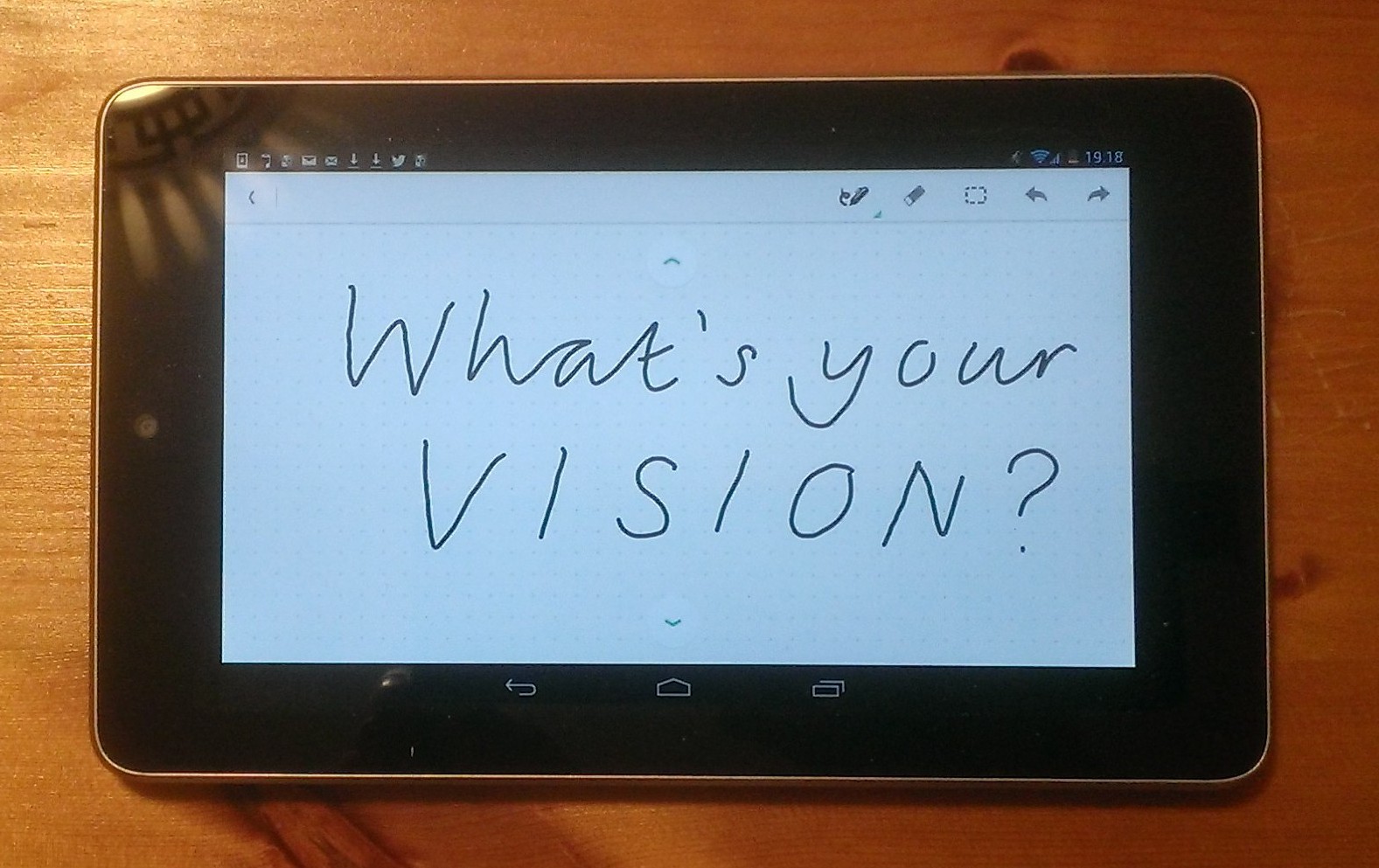
Write down the vision on tablets, smartphones, laptops or post-its - whatever it takes.
Write down the vision on tablets, smartphones, laptops or post-its – whatever it takes.

I’ve been spending time of late clarifying what I’m shooting at as my lifetime vision. In the process, I’ve rediscovered how writing that vision down and keeping it visible is energising and encourages me to take steps towards its fulfilment.

The prophet Habbakuk captured this truth when he penned the words: ‘Write down the vision and make it plain on tablets, that he may run who reads it.’ (Habbakuk 2:2)

I believe that, with a corporate vision, ‘that he may run’ refers to keeping the vision clear enough to encourage the reader to ‘run and tell others’. And a personal vision needs to be a visible, quickening exhortation to ‘run with it’ and put it into practice.

Connect your Charger

To remind me of my vision, some time ago I typed it onto the lock screen of my tablet so I’d read it every time I used the tablet (a digital one, unlike like the wooden ones of Habbakuk’s day).

After a while I overlooked the vision in my haste to open whatever app. Until one day, with the battery running low, I noticed these words right next to my vision statement: ‘connect your charger. ‘

To bring the vision alive, we need to connect with the Charger, who inspired it in the first place. Discovering or re-energising our vision involves setting aside quiet time and space to engage with God.

Habbakuk declared before receiving God’s instruction to ‘write down the vision’: ‘I will stand my watch and set myself on the rampart, and watch to see what He will say to me.’

(I’m writing this on a stormy autumn day in central Scotland, so a rampart perhaps wouldn’t be the most conducive place).

What would living your dream look like?

As I made space to revisit my vision recently, I asked myself the question: “If I was living the dream, what would it look like?”

I already had an overriding lifetime vision, but also wanted to articulate the desires that flow from the dream, so I began to write down what shape these aspirations would take when realised.

Some of the areas were to do with intimacy with God, family, positively impacting others, business, health, good stewardship, relationships and recreation.

You can start living the dream now

What was obvious to me was that I could live out every single one of my desires now. Yes, the grand vision will take some time to manifest fully. But I can be living it now.

For example, if you or I want to influence thousands of people transformationally in our lifetimes, each one is an individual. So how we step out right now to touch lives one by one is part of that vision.

I can draw on divine inspiration right away. I can enjoy a half hour walk on the road to better fitness today (once the storm dies down!). I can reach out to someone to build a stronger bond of friendship. I can bring hope to someone today.

Where will you write your vision and desires to keep them visible? And what steps can you take today to start living the dream?

7 keys to help make your 2014 a vintage year

Insights inspired by 7 top vine-growers in A Year In Burgundy

One of the first films I tippled this year was A Year In Burgundy. It followed the lives of a number of winemakers and their vines through the changing seasons of the year.

The annual cycle that produces some of the world’s finest wines yields a number of valuable life lessons.

Learning from the ultimate Vine-grower is key ©shutterstock.com/Yellowj
Learning from the ultimate Vine-grower is key
©shutterstock.com/Yellowj

1   Value your uniqueness

Science and market expectations are pushing some winemakers towards producing samey wines, as one maker observed. As long as this standardisation is resisted, the uniqueness of each vintage can be enjoyed, drawing on each vintner’s unique personality.

Similarly, you and I are unique and we don’t need to try to live out someone else’s life. Each of us is a one-off creation with a distinctive ‘flavour’ based on a special personality, set of talents and individual assignment.

2   Take time to take root

Vines need to be allowed time to put down deep roots, which can stretch down as far as four or five metres. This means relying on the rain alone – even punctuated by dry spells – and not frequent irrigation, which leads to shallow roots.

In cultivating our relationship with God, we need to develop a strong root system by spending quality time focusing our affections on Him and learning to rely on Him, whatever the weather of circumstances. ‘Irrigation’ by other people’s revelations and insights, while valuable, is not enough to enable us to develop those strong tap roots grown through one-on-one time with God himself.

3   You have to be part of part of the vine’s life

One vine-grower summed up her approach to understanding what the vine needs to be able to thrive: “You have to be part of the life of the vine.”

Unwittingly, she hit on a vital key to grasping our true identity and thriving in life. Jesus said: ‘I am the vine, you are the branches, He who abides in me, and I in him, bears much fruit.’¹

A branch is part of the life of the vine, as long as it abides in – stays connected to – the vine. You and I, through faith and ongoing relationship with him, are part of the life of Jesus. Your fruit – character, atmosphere, influence, accomplishments or impact on others – is actually his fruit, which he nurtures, nourishes and releases from within you.

4   Create breathing space

During summer, the above winemaker gathered together the topmost vine branches, bent them over in an arch and tied them to the top trellis wire. She doesn’t tie them together too tightly, she explained, “so that they can breathe.”

Consider trellises as a metaphor for frameworks, structures and systems. While important, the system needs to be the servant and not the master. Vine-growers grow vines that bear fruit, not trellises. In church, work and privately, if we bind life too tightly to the institution, ‘the way things are done around here’ or too rigid a personal masterplan, we run the risk of operating in a legalistic, rules-based way that stifles life and lasting growth.

5   Time your harvest well

Timing the harvest of the ripe grape clusters is crucial, and closely studying the weather is key to picking the optimal time. Rain too close to the harvest can cause oversized grapes, hailstones damage the grapes, and, if left on the vine too long, the grapes will spoil.

Picking our moments in spiritual, workplace and relational contexts is also vital. It may be a question of when to share our faith, offer to pray for someone or take part in an outreach. Or it could be when and how to approach a prospect, challenge a colleague or launch a new initiative. Staying tuned into God for wisdom on timing is key.

6   Value pruning

Pruning of vine branches takes place at the end of the season, strengthening the roots for the next year’s harvest. The cut branches are then burned and the ashes used to enrich the soil. There are areas where we all need ‘pruning’, both in the sense of removing material ‘stuff’ from our lives, as well as activities, habits and mindsets.

Something that was fruitful in a past season of your life, that was good for that phase, may now need to be laid down. Does a particular job function or ministry role need now to make way for your next assignment, or perhaps for a dream that you have been putting off for months or even years?

7   Offer quality fruit

During the harvest, one exercised winemaker berated some of the grape pickers for putting damaged fruit into the harvesting paniers. Appealing them to respect his work, he then showed them how to remove the damaged grapes and let them fall to the ground. Thinking this through, I am challenged always to offer the best I can, whether in business, ministry or relational life, and not cut corners.

In this new growth cycle of your life in 2014, how does the vine-growing year inspire you to make sure it’ll be a good vintage? Learning from the ultimate Vine-grower², as I continually find,  is key.

¹   John 15:5 NKJV     ²   John 15:1 NKJV

Practice, not perfectionism, makes perfect (pots)

Artists David Bayles and Ted Orland, in their book, Art & Fear tell of an art teacher who experimented with the grading system for two groups of students.

Not quite your cup of tea? Keep practising! Image © www.istockphoto.com/wildcat78
Not quite your cup of tea? Keep practising!
Image © http://www.istockphoto.com/wildcat78

The story illustrates how practice can make perfect, while perfectionism can hinder progress.

Here’s what happened:

The ceramics teacher announced on opening day that he was dividing the class into two groups. All those on the left side of the studio, he said, would be graded solely on the quantity of work they produced, all those on the right solely on its quality.

His procedure was simple: on the final day of class he would bring in his bathroom scales and weigh the work of the “quantity” group: fifty pounds of pots rated an “A,” forty pounds a “B,” and so on.

Those being graded on “quality,” however, needed to produce only one pot – albeit a perfect one – to get an “A.” Well, came grading time and a curious fact emerged: the works of the highest quality were all produced by the group being graded for quantity.

It seems that while the “quantity” group was busily churning out piles of work – and learning from their mistakes – the “quality” group had sat theorising about perfection, and in the end had little more to show for their efforts than grandiose theories and a pile of dead clay.

Learn from our mistakes

The story certainly challenges me to examine areas where I may be holding back until I work out the ideal solution in my mind before taking the first step in a project or venture.

In today’s climate of often excessive risk management, we can ironically run the risk of failing to make progress by trying to avoid failure. The ‘ideal solution’ will never materialise unless we experiment and learn from our mistakes.

Being involved in corporate governance in one of my roles, I appreciate the importance of taking an overview of those things that could go wrong in an organisation and putting the systems in place to minimise their likelihood. But we still need to take calculated risks in order to reach the best outcomes.

Waiting for the perfect solution to crystallise before taking action is a common problem among bloggers. Sometimes the best answer is, as the saying goes: just ship it! In other words, just write what’s on your mind and post it. Beat the blog post-ponement syndrome!

What are the areas in your life where you need to make a few pots – or even break a few pots – to see some progress?

More fruitful life beyond the man drawer

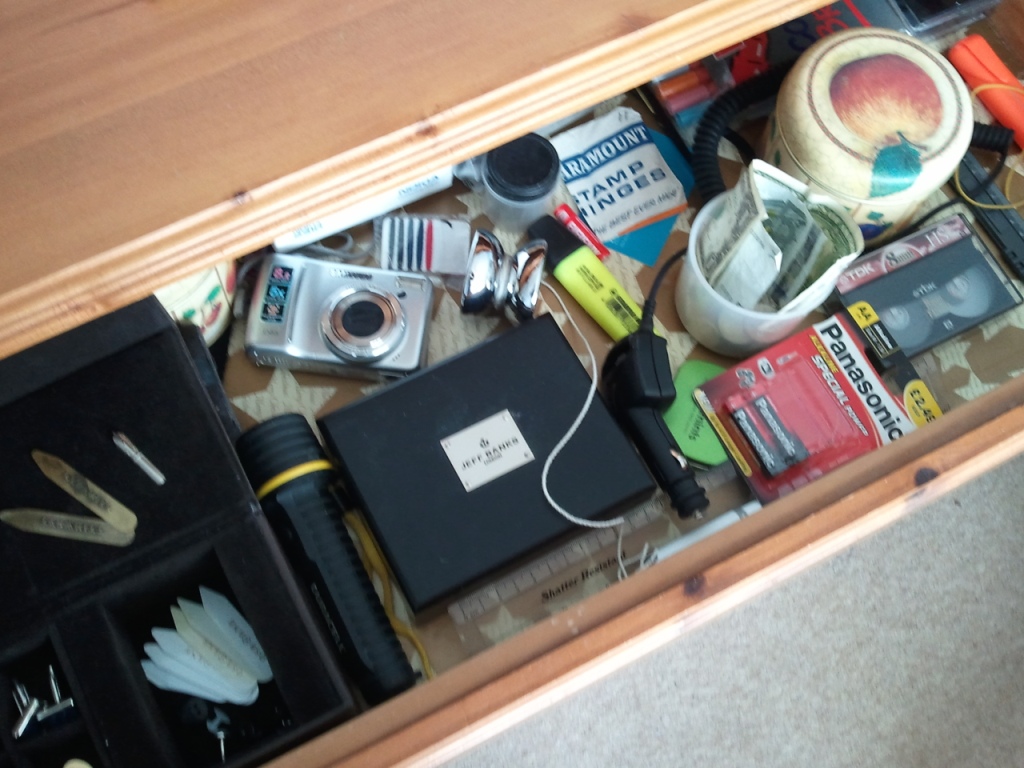
In a hilarious part of his routine a few years ago, British comedian Michael McIntyre delved into every male’s trusty treasure trove – the man drawer.

The man drawer
The man drawer

If you’re a man, you possess a man drawer. If you’re a woman (this post is relevant to you too), you know a man who has one.

It’s the sole domestic storage area that every man needs – or thinks he needs. As McIntyre paints it so vividly, it contains batteries of indeterminate life, instructions for appliances we don’t own any more and coins of foreign currencies made obsolete by the euro.

If our approach to planning involves only a catch-all to-do list, this is a bit like rummaging randomly through the man drawer.

Without some kind of structure, our actions are triggered by whatever items grab our attention. “Yay, it’s that Sony Walkman cassette player you can’t buy in the shops anymore. I think I’ll see if those old cassettes from my student days are still in the loft.”

Branching out for fruitfulness

Virtually all time management approaches I’m aware of recognise the need to compartmentalise the areas of our lives. These are the logical extension to the man drawer – more like a chest of drawers.

The key areas may be role-based – leader, parent, financial steward – or settings based – company, athletics club, church. They will most likely be a combination of both.

In the parable of the vine (John 15), Jesus describes believers as branches of himself, the true vine. In wine-growing, a branch that grows from the main vine is called a cordon or leader. These leading branches bear other smaller branches from which the grape clusters grow.

I like to think of the sub-branches as a picture of the areas of our lives in which we are called to bear fruit. These could be workplace, ministry, family, finances, spiritual growth, wellbeing and relationships. They all form part of our lives – the ‘leaders’ – and are also connected to the same, true rootstock himself.

Taking a regular overview of our lives involves looking to the vine from which we grow, knowing that he supports, informs and empowers us in each branch of life.

We can use this picture as a way of reviewing our ‘sub-branches’, knowing they are all part of the overall picture of our lives. And we can remind ourselves that they are all connected to, fed and nourished by the true vine himself as we stay in step with his purposes.

6 steps from saturation to regeneration

Time to lighten the load?Image istockphoto.com
Time to lighten the load?
Image © istockphoto.com

Overload is a common symptom of twenty-first-century life. The weight of expectation from employers, clients, family, friends and even ourselves often leads us to take on too much and reach saturation. Be encouraged. Help is at hand.

There’s a remarkable material called activated carbon cloth (not the above-mentioned help, but stay with me).

It has an amazing property. Every visible square metre has an actual 100,000 square metre surface area.

It’s used in filters, protective clothing and wound dressings to adsorb – take up – odorous or harmful molecules. The molecules accumulate on its vast ‘hidden’ surface area. But even this techie textile has its limits: it too eventually becomes saturated.

However, it can be regenerated by an electrical charge, heat or washing. It’s then ready for re-use.

Here are six scriptural steps towards our own regeneration after – or preferably before – we reach saturation:

1 Approach: Come to me

In the parable of the yoke¹, Jesus said: “Come to me all you who labour and are heavy laden.” There’s a job description with which many of us can identify. The first step is to accept Jesus’ open invitation to approach him in prayer.

2 Attach: Take my yoke

The good news is that we’re offered one half of a double yoke – the crossbar fitted to a pair of oxen – to lighten our load. Through it, we get attached to an ox with infinitely greater pulling power than ours: Jesus himself. This is a bit like attaching my depleted 1.5 volt battery to his 1000 megawatt power station for a charge-up.

3 Abandon: Cast your burden

We’re encouraged to ‘cast our burden’² onto Jesus’ shoulders. Be honest and specific about which particular cares and concerns you’re offloading. And know that the floorboards of heaven won’t crack under the strain of your erstwhile ‘stuff.’

4 Appropriate: Learn from me

Jesus is, among other things, ‘gentle and humble in heart.’ We may think: ‘That’s fine for him, but it’s the last thing I feel.’ But the point is that, through our yoke of connection, his strengths flow to us. And these include the very antidotes to the burdens we’ve been carrying.

When he says: “Learn from me,” he means learning by his example and what he teaches in scripture.  We’re also taught by the Holy Spirit, the ‘Counsellor’ and ‘Spirit of truth… (who)…will guide you into all truth.’³ The Spirit points us to and explains scripture, and reveals truth to us through wider revelation too.

5 Accept rest: Find rest for your souls

Peace of mind is the promised outcome of all of the above. The key is not trying to figure out the solution solely in our strength. We come to enjoy peace within despite the external circumstances, because of our heart-to-heart connection with the Prince of peace himself.

There’s a practical side to rest here too. We need to build in times of rest to our lives, punctuating both the days and the seasons, in order to stay fresh.

6 Abide: If you abide in me…†

Staying in living union with Jesus is the preventive medicine against saturation. When we accept him as Lord and Saviour, we already have that union. The key is to remain in close, prayerful relationship with him and in agreement with his words – highlighted to us through scripture and the Spirit’s direct and indirect revelation.

How does our perception of God’s size and our sense of connectedness – or otherwise – to him influence our own capacity to stay fresh and energised?

¹ Matthew 11:28-30 NKJV     ² Psalm 55:22 NKJV

³ John 16:13 NKJV                    † John 15:7 NKJV