
Fruitful 2015 – 3: Expanding your sphere

“We are called to be thermostats, not thermometers – affecting our environment, not reflecting it,” Ron Hembree once said.

Adding colour to lives: our spheres of influence c Elena Dijour | shutterstock.com
Adding colour to lives: our spheres of influence
© Elena Dijour | shutterstock.com

Everyone has a sphere of influence. Yours may principally be your workplace, your business, your sport, creative expression or place of learning. Or it may be a mix of home, family and local community, or your church ministry and the community it impacts. You probably have a main sphere and a few smaller ones.

Shifting the atmosphere in your sphere

We are dispensers of the superior realm of heaven into the earth – carriers of the goodness and grace of God, and the creative solutions He has for every situation, working through us. Biblically, we‘re called the ‘fragrance of Christ’, His ‘ambassadors’, ‘vine branches’, and carriers of ‘fountains of living water’. We’re not alone: we have the presence and resources of the King of the universe. As well as saying, “Go,” Jesus said, “I am with you.”

Taking the water balls in the picture as metaphors for our spheres, God is ready to fill your sphere with His influence using you as the connector valve. He wants to change the atmosphere within each sphere, as you partner with Him in exuding His realm and presence.

There’s no sacred-secular divide

The spheres of God’s kingdom extend beyond the church. A friend told me recently that he had been considering ‘scaling down his work to focus more on the kingdom’. What he meant was spending more time on church ministry and outreach – His primary sphere. But his reference to kingdom as being more focused on church-related work underestimates the much broader scope of the kingdom.

We’re called to reign in life

We’re called to reign in life’s situations: ‘Those who receive the abundance of grace and the free gift of righteousness’ will reign in life through … Jesus Christ.’¹

The kingdom is within you and me by faith in Jesus as our Saviour and Lord. God doesn’t impose His kingdom, although He could easily do so.  I believe that, in His sovereignty, He chooses mainly to advance His rule and reign on earth through willing people. And He chooses you and me – in whatever sphere we occupy and influence, from our family and neighbourhood, to our job, business or golf club.

Our impact is not chiefly about quoting scripture – although it sometimes involves that. It’s about how we do life, for example in forming relationships, expressing creativity and approaching work, in ways that bring about positive transformation in other people’s lives.

Prepare for sphere expansion

Paul spoke of his ‘sphere to which God appointed’² him as he wrote to the Corinthians, who were within that sphere.

This passage is sometimes interpreted with an emphasis on the limits on Paul’s authority, but Paul in fact expects to see his sphere extending. He expresses hope that, as the Corinthians’ faith is increased, his sphere will be enlarged to cover the regions beyond.

But don’t get fixated on the seeming current size of your sphere – big or small – or even a recent sphere reduction. Six years ago, my business was hit by the 2008 recession, along with government policy changes that saw the kind of contracts I’d specialised in for five years dry up almost overnight.

While business has recovered well since then, I know that I now have a broader sphere involving more than my immediate enterprise, embracing writing and song-writing to touch more lives. In the lean times I was able to develop those areas that were vital to my wider sphere.

God can turn around even life’s setbacks to develop you or me for sphere expansion, perhaps taking us into the arena that He meant for us all along. Could your sphere be a new business, a learning establishment you’re called to, the impact of your artistic creativity, writing or blogging? Perhaps it’s the voluntary organisation or post-retirement project you’re involved in, or the young lives you impact in your family, church, community or city.

As Vance Havner said, “The tiniest post office can bear a letter that may wreck or bless a nation. And the simplest life can relay blessings that may rock a continent toward God.”

Let your letter be one that blesses increasingly, and let there be an expansion in your God-appointed sphere in the year ahead!

¹ Romans 5:17

² 2 Corinthians 10:13-15
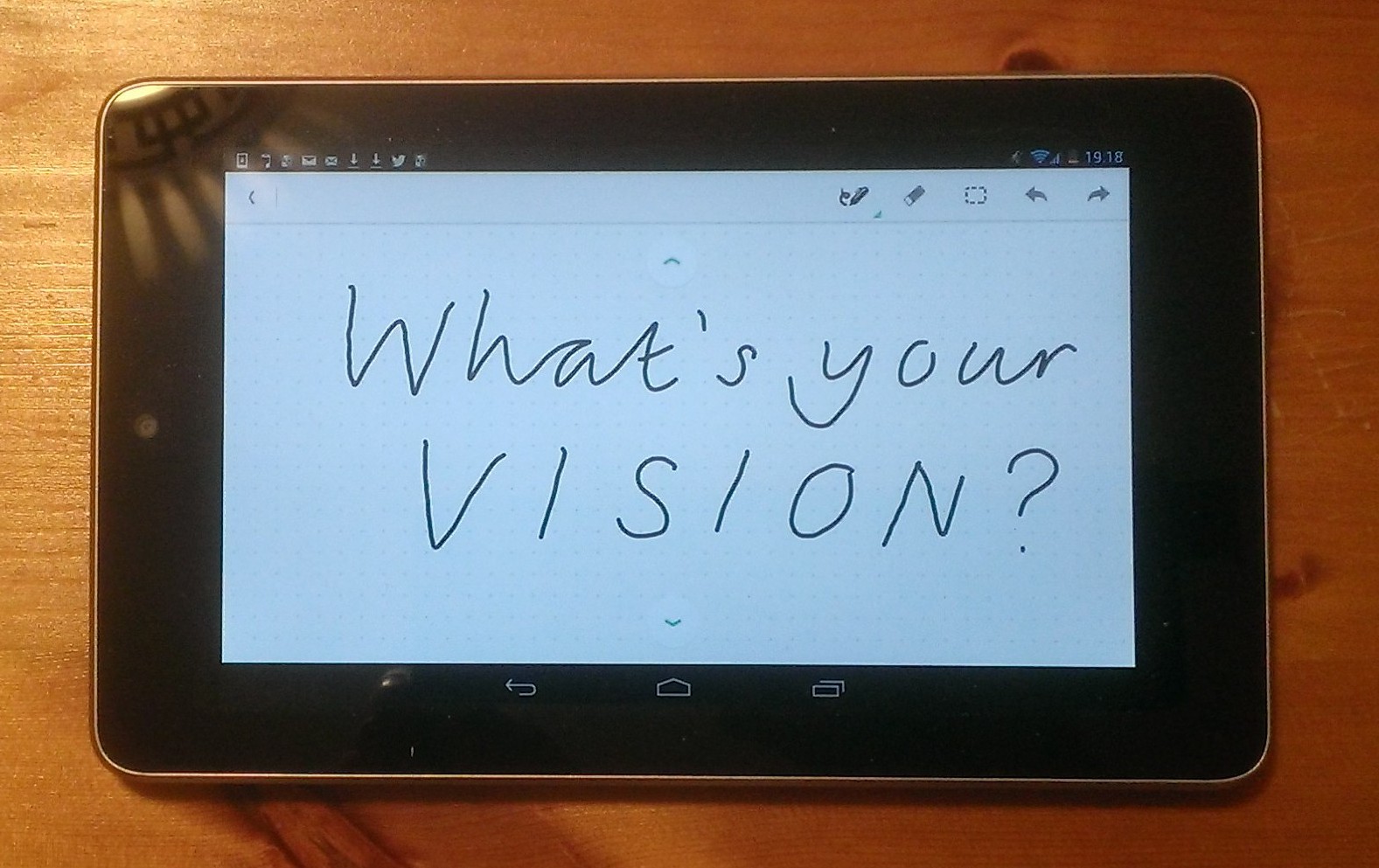
Why it’s vital to keep your vision visible

‘Who shoots at the midday sun, though he be sure he shall never hit the mark, yet as sure as he is he shall shoot higher than who aims at a bush,’ wrote the poet, Philip Sidney.

Write down the vision on tablets, smartphones, laptops or post-its - whatever it takes.
Write down the vision on tablets, smartphones, laptops or post-its – whatever it takes.

I’ve been spending time of late clarifying what I’m shooting at as my lifetime vision. In the process, I’ve rediscovered how writing that vision down and keeping it visible is energising and encourages me to take steps towards its fulfilment.

The prophet Habbakuk captured this truth when he penned the words: ‘Write down the vision and make it plain on tablets, that he may run who reads it.’ (Habbakuk 2:2)

I believe that, with a corporate vision, ‘that he may run’ refers to keeping the vision clear enough to encourage the reader to ‘run and tell others’. And a personal vision needs to be a visible, quickening exhortation to ‘run with it’ and put it into practice.

Connect your Charger

To remind me of my vision, some time ago I typed it onto the lock screen of my tablet so I’d read it every time I used the tablet (a digital one, unlike like the wooden ones of Habbakuk’s day).

After a while I overlooked the vision in my haste to open whatever app. Until one day, with the battery running low, I noticed these words right next to my vision statement: ‘connect your charger. ‘

To bring the vision alive, we need to connect with the Charger, who inspired it in the first place. Discovering or re-energising our vision involves setting aside quiet time and space to engage with God.

Habbakuk declared before receiving God’s instruction to ‘write down the vision’: ‘I will stand my watch and set myself on the rampart, and watch to see what He will say to me.’

(I’m writing this on a stormy autumn day in central Scotland, so a rampart perhaps wouldn’t be the most conducive place).

What would living your dream look like?

As I made space to revisit my vision recently, I asked myself the question: “If I was living the dream, what would it look like?”

I already had an overriding lifetime vision, but also wanted to articulate the desires that flow from the dream, so I began to write down what shape these aspirations would take when realised.

Some of the areas were to do with intimacy with God, family, positively impacting others, business, health, good stewardship, relationships and recreation.

You can start living the dream now

What was obvious to me was that I could live out every single one of my desires now. Yes, the grand vision will take some time to manifest fully. But I can be living it now.

For example, if you or I want to influence thousands of people transformationally in our lifetimes, each one is an individual. So how we step out right now to touch lives one by one is part of that vision.

I can draw on divine inspiration right away. I can enjoy a half hour walk on the road to better fitness today (once the storm dies down!). I can reach out to someone to build a stronger bond of friendship. I can bring hope to someone today.

Where will you write your vision and desires to keep them visible? And what steps can you take today to start living the dream?

Which generation describes your identity?

I recalled this morning an image of a fountain that came to mind one day last autumn when I’d obviously been thinking about coping with my responsibilities towards younger and older family members.

At the time, refusing to identify with a thought moments before, I journaled, “I’m not in the sandwich generation, hemmed in by both sides.” I chose a better phrase to partner with: “I’m in the cascade generation, flowing with heaven from God’s perspective onto those in older and younger generations who need love and power.”

New generation: out of the sandwich and into the flow!

It’s all too easy when under pressure to take on a false sense of identity that puts more emphasis on the burdens than on the answer that lightens the load, both for you and me and the generations around us.

Jesus said to the Samaritan woman at the well, “whoever drinks the water I give them will never thirst. Indeed, the water I give them will become in them a spring of water welling up to eternal life.”¹

This spring of water brings refreshment and restoration for ourselves, but also a flow of hope, healing and creative solutions for the individuals, families and communities whose lives we touch.

We’re told in the same story that the woman left behind her water jar at the well – on one level a symbol of the burdens she carried? – and went back to town to spread the news about Jesus, and drew people to him. Some would come to drink the supernatural living water of his Spirit for themselves, then pass it on to others in the region.

Immediately after writing these reflections this morning, the first song I heard as I turned on my car stereo was Matt Redman’s We Are The Free, in which the chorus ends with the line, “We are the free, the freedom generation.” Absolutely!

If you’re in need of refreshment this week amid competing pressures, just ask Jesus for a drink! It’s free, and we’re a generation that’s set free from the labels and identities that the voice of oppression would put on us.

¹ John 4:13